Invention: A Playful Handwritten Font That Feels Like You
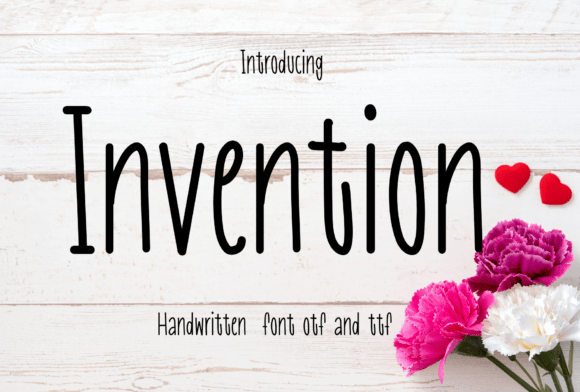
If you've ever spent minutes tweaking letter spacing on a greeting card only to realize it still looks "designed" instead of heartfelt—you’re not alone. That’s where Invention steps in. It’s not just another script font. It’s a tall, slender, handwritten typeface with subtle quirks—slight variations in stroke weight, gentle slants, and organic line endings—that mimic real pen-on-paper movement. No stiff uniformity. No robotic repetition. Just warmth, personality, and quiet confidence.
What makes Invention stand out isn’t flashiness—it’s authenticity. Its slim silhouette keeps layouts airy and modern, while its slight irregularities (a lifted terminal here, a softened curve there) prevent visual fatigue. Unlike many decorative scripts, Invention doesn’t sacrifice legibility for charm. You can use it at 14pt in a blog quote or scale it up to 120pt on a nursery wall—and it reads clearly both times.
Why Designers Reach for Invention First
Professionals choose Invention when they need handwriting that feels intentional—not accidental. It bridges the gap between “handmade” and “polished.” Think of it as the font equivalent of a well-pressed linen shirt: relaxed but refined.
Its lowercase letters have open counters and generous x-heights, which boost readability in digital spaces like Instagram Stories or email headers. Uppercase characters maintain rhythm without shouting—ideal for logo lockups where friendliness matters more than dominance. And because every glyph was drawn by hand (not algorithmically generated), spacing feels intuitive, not engineered.
Real Projects, Real Results
Here’s where Invention earns its place in your toolkit:
- Mother’s Day cards and gift tags: Its gentle curves soften sentiment without veering into cutesy territory—perfect for messages that balance love and sincerity.
- Children’s book illustrations: Use it for character speech bubbles or chapter titles. Kids respond to its approachability, and parents appreciate how cleanly it renders on print and screen.
- T-shirt and Cricut projects: The clean vector outlines hold up beautifully in vinyl cutting and embroidery digitizing—no jagged edges, no rendering surprises.
- Social media quotes: Pair Invention with a neutral sans-serif body font (like Inter or Open Sans) for contrast that guides attention without competing.
- Educational handouts and classroom posters: Teachers report higher student engagement when vocabulary lists or weekly schedules use Invention for headings—it signals “this is for you,” not “this is from the district.”
Branding teams also lean on Invention for sub-brands or seasonal campaigns where warmth supports strategy. A wellness startup might use it for their “Self-Care Sunday” newsletter series; a local bakery could feature it on seasonal menu boards—never as the primary logo, but always as the voice behind the brand.
Technical Strengths You’ll Actually Notice
Invention ships in both OTF and TTF formats—so whether you're on macOS with Adobe Creative Cloud or using Windows with Canva Pro, compatibility isn’t a question. It installs like any system font: double-click, hit “Install,” and it appears instantly in Illustrator, Photoshop, InDesign, Word, PowerPoint, Figma, and even Google Docs (via the “add fonts” extension).
It includes full Latin character sets—uppercase, lowercase, numerals, punctuation, and multilingual diacritics. More importantly, it’s PUA encoded. That means special ligatures and alternate characters (like a swash “Q” or contextual “t”) appear reliably across platforms—no font substitution, no missing glyphs in exported PDFs.
No extra plugins. No cloud dependencies. No learning curve beyond selecting and typing. If you’ve used fonts before, you already know how to use Invention.
A Note on Usage Balance
Like any strong personality, Invention shines brightest when given space to breathe. Avoid stacking it with other script fonts or overloading paragraphs with it. Reserve it for moments that benefit from human tone: headlines, pull quotes, call-to-action buttons, signature lines, or short labels.
For longer text blocks—think blog intros or product descriptions—pair it thoughtfully. Try Invention for the headline, then switch to a highly readable sans-serif (e.g., Lato or Montserrat) for body copy. This contrast builds hierarchy naturally and keeps users reading.
Who Benefits Most—and Why
Creative freelancers love Invention because clients consistently describe it as “the one that felt right.” It shortens revision cycles—fewer “make it warmer” or “less corporate” requests when the font already carries emotional resonance.
Small business owners appreciate how quickly it elevates DIY materials. A handmade soap label set in Invention communicates care and craft far more effectively than generic script fonts found in free bundles.
Educators and therapists use it in printable resources—behavior charts, emotion wheels, mindfulness prompts—because its friendly presence lowers psychological barriers. Children and neurodivergent learners often find it less visually overwhelming than tightly spaced or high-contrast alternatives.
Even developers building custom WordPress themes or Notion templates include Invention in their design systems—not for code, but for client-facing UI elements where tone impacts trust.
Before You Download: A Practical Check
Ask yourself two questions:
- Is this for a moment that needs humanity? If yes—invitations, personal branding, community newsletters, or educational tools—Invention fits.
- Do I need broad language support or complex typographic features? Invention covers English, Spanish, French, German, Portuguese, and most Western European languages. It does not include Cyrillic, Arabic, or East Asian scripts—but that’s by design, not limitation.
There’s no “best” font universally—only the best tool for your specific communication goal. Invention excels when your priority is connection over complexity, clarity over clutter, and authenticity over artifice.
It won’t fix weak copy. It won’t replace thoughtful layout. But when paired with strong content and smart design decisions, Invention helps your message land—not just seen, but felt.